Your Opponents Should
Fear You.
360 pages of ruthless competitive strategy pulled from chess, MMA, boxing, jiu-jitsu, poker and more. A complete system for finding and exploiting every advantage available to you.
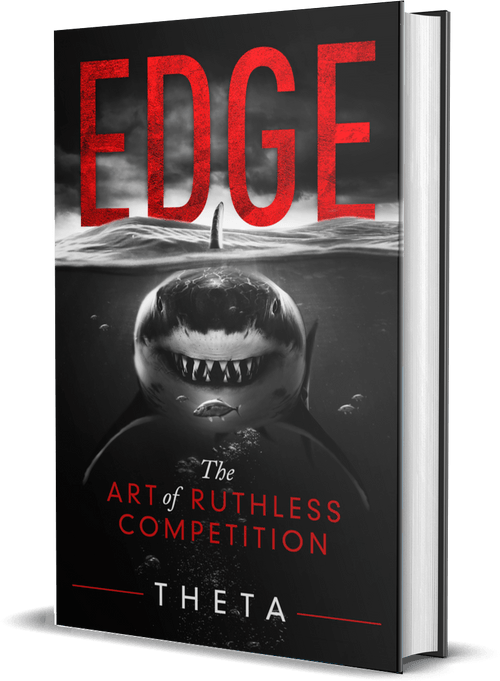
360 pages of ruthless competitive strategy pulled from chess, MMA, boxing, jiu-jitsu, poker and more. A complete system for finding and exploiting every advantage available to you.
You study the game. You grind the hours. You watch the tutorials. And you still lose to people who shouldn't be beating you.
Knowing more about the game doesn't make you a winner. Most players obsess over mechanics, memorize builds, and drown in guides. Then they walk into a match and get dismantled by someone who plays half as many hours.
Because that player is reading your patterns, exploiting your psychology, and forcing you into decisions that feel right but lead straight to a loss. You don't even realize it's happening. By the time you figure out what went wrong, the match is already over.
Edge calls this being a sucker: walking into a zero-sum environment without an actual competitive advantage and expecting to win anyway. Luck won't save you. Talent alone won't do it either. Grinding more hours on the same broken approach only makes you a harder-working sucker.
You need a system for finding and exploiting unfair advantages. Edges that overwhelm your opponents and convince them they never stood a chance. That's what this book gives you.
A systematic process for dismantling any opponent in any competitive game.
Build a vocabulary of first principles that transfers across games. Losing games vs. winning games. Randomness. Information asymmetry. Snowballing. Develop the appraisal ability to read any competitive situation and know exactly what it's worth.
Humans are the weakest link in any system, and they're predictably weak. Learn the VUCA framework: Volatility, Uncertainty, Complexity, and Ambiguity. Use it to short-circuit your opponent's decision-making until they implode from within.
Casual play and real competition are separated by a chasm. Eliminate scrub mentality. Build anti-strategies. Kill your autopilot. Weaponize pressure. When it's time to compete, there is no mercy.
Twelve competitive situations. Three scores. Find out which axis is costing you matches, and which chapters fix it.
Take the testFifteen rounds of rock-paper-scissors against a bot that reads you. Then a full breakdown of exactly how it did it.
Play a round“Competition is not about who knows more about the game. It's about who knows how to win.”
— Edge: The Art of Ruthless Competition
No abstract theory. Every concept is grounded in games where real stakes are on the line.
Fischer's never-played openings wiped out years of Soviet preparation
Tyson's peekaboo style: pure volatility, built to overwhelm bigger men
Danaher's leg-lock system: old parts, assembled into a new machine
Donkeyspace: the profit hiding inside "irrational" moves
The '85 Bears hit the quarterback until he was too terrified to play
The 76ers' Process: losing on purpose as a second-order strategy
Cannae: Hannibal's flank erased a Roman army nearly twice his size
How Astralis systematized CS:GO, and why anti-stratting ends every casual era
The ideas Edge is built on, defined in plain language. Start with any of them.
The unfair advantage every strategy is built to exploit
When emotions take over decisions, after a loss or with a lead
Volatility, uncertainty, complexity, ambiguity: aimed at an opponent
Every move is bad, and you still have to move
The player who loses to rules that exist only in their head
The game beyond the game, where many edges hide
Lose on purpose in practice so you lose less when it counts
Why what wins at mid level stops working at the top
This book changes how you approach competition entirely.
Theta's experience and ruthless winning concepts come through on every page. If you're serious about competing, this is the playbook you've been missing.
I've seen significant improvement in my performance and enhanced decision-making since reading Edge. The frameworks are practical and immediately applicable.
“Make them submit mentally, and it won't matter how much bigger, stronger, or better than you they are. That's what edges are all about.”
— Edge: The Art of Ruthless Competition
The introduction, unabridged. Judge the book by its first page.
This book will teach you how to win in the most ruthless way possible.
What you’re about to read can be applied to whatever it is you play, whether it’s a mainstream sport, a board game or a first-person shooter. No matter what your skill level is, you will become more effective as a player after you read it - that is a guarantee.
The focus here is on strategy as a concept. To be more specific, a strategy is a system for exploiting unfair advantages, also known as edges. If edges aren’t involved, you aren’t strategic, nor are you tough, cool or courageous. You’re a sucker.
An edge is an asymmetry of some kind - a difference between two opposing forces that provides an outsized benefit to one side. Think of a heavyweight fighting a bantamweight, and you can begin to see where edges emerge. The larger fighter has size and strength, while the smaller fighter can leverage speed and agility.
Competitive games worth a damn are zero-sum, meaning there can only be one winner and one loser. One player’s gain is another player’s loss, and vice versa. These types of games punish the kind-hearted and reward the ruthless.
You become a sucker whenever you walk into such a zero-sum environment without an edge and still expect to win. If you think luck, good looks, or in-born talent alone will carry you through, you’re wrong. Therefore, the single most important rule of competitive strategy is Don’t be a sucker.
The first sucker mistake many people make is that they think about games through the lens of the game alone. They believe they’ll get better results if they spend their lives in seclusion, learn every tiny detail about the game, and transform themselves into a walking, talking library of knowledge.
If there’s nothing else you take from what you’re about to read, at least remember this: competition is not about who knows more about the game, it’s about who knows how to win. Winning is built on knowledge of your opponent, especially their human weaknesses, and then shaping their competitive behavior.
Much of competitive success is about forcing your opponent to make bad decisions and shaping their thought processes so they become a sucker against their will. Your goal is to make them mentally implode, throw away any edges they may have, and then give up before the match has even been decided.
Make them submit mentally, and it won’t matter how much bigger, stronger or better than you they are. That’s what edges, and this book, are all about: overwhelming advantages that convince your opponent they stand no chance. If you did your job, your opponents will walk away from matches with a look of frustrated bewilderment - “How did this happen?” should be written all over their faces.
You do need to have a clear understanding of the game itself in order to win (which is what the first section, Play the Game, is all about), but if you only think about competition through the game itself then you’re missing the point. You aren’t playing against the game, you’re playing within it. Your opponent is the thinking, feeling human in front of you, and that should therefore be your primary focus once you understand the game at an acceptable level.
Some of the best competitors are simple-minded terminators who can barely describe what they do in the game, much less teach you anything useful. This is a frustrating fact for many aspiring competitors, but it’s a harsh truth that you need to internalize if you want to break the chains of suckerdom.
The purpose of this book is to teach you how to impose your will on your opponents and shape them into players you can predict and defeat. This is both art and science, filled with both concrete examples and abstract, often paradoxical, concepts.
But as you read through these pages, the message remains the same: to win, you must ruthlessly use every edge at your disposal to strike down your opponents. You won’t make many friends, and no doubt you’ll make enemies, but you’ll win.
Although there will be examples to help you understand, at no point will this devolve into specific formulas for winning. The overall goal with this book is to help you become a sharp player — someone who knows how to find edges and win. This is an ongoing evolutionary process that never stops, because the games we play never stay static.
Only suckers believe there’s a single, sustainable algorithm for defeating other thinking humans. All competitive success is temporary, and what works in one era for one type of game may not translate into different scenarios.
If you pay attention to what’s ahead and build upon it in your own way, you will tilt the odds strongly in your favor. In other words, you’ll have an edge.
360 pages. One system. Every competitive advantage you need to take the top spot and keep it.
Available in paperback, hardcover, Kindle & Audible